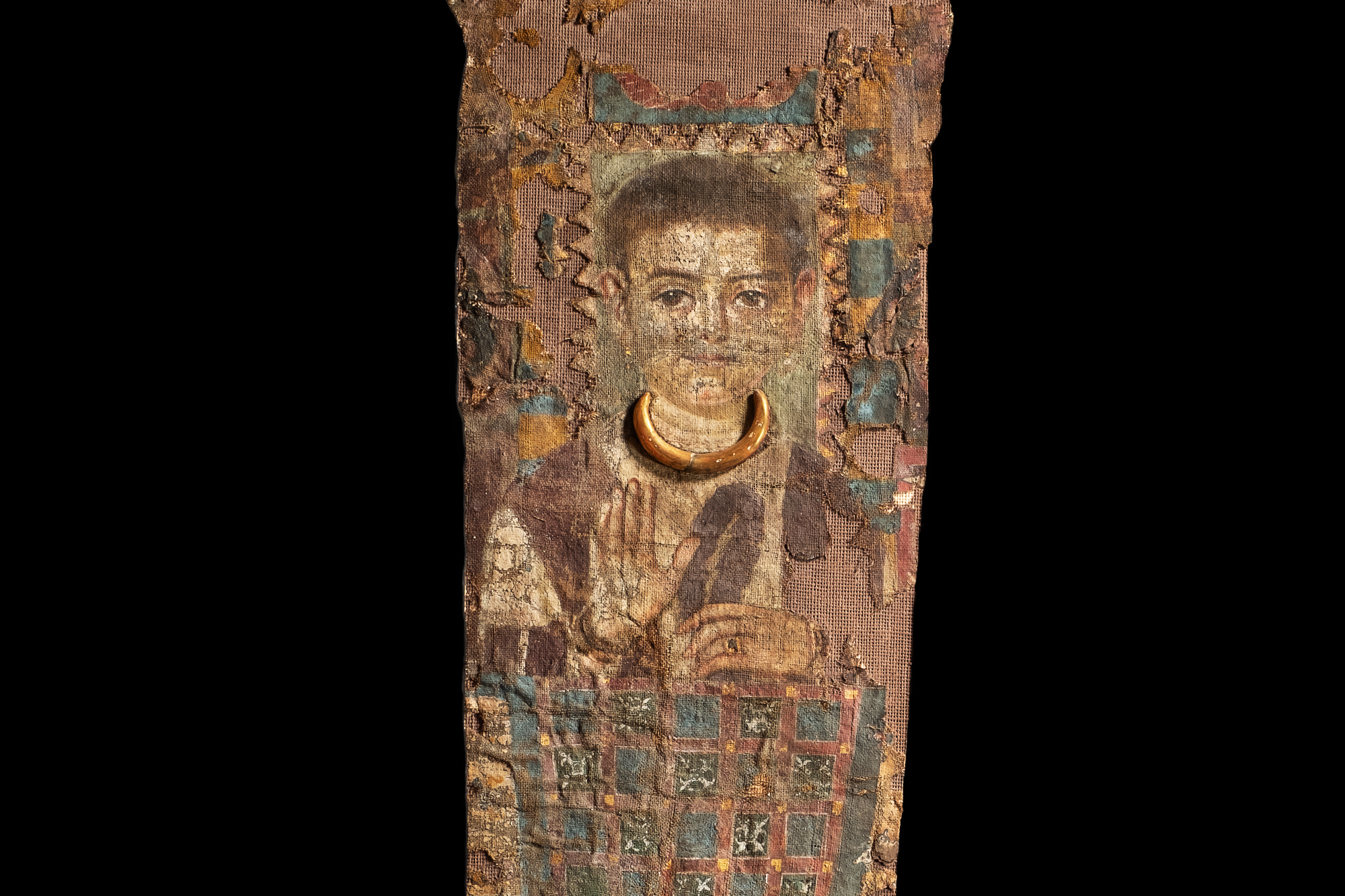
Artefacts in focus #6: a shroud for a young girl
In January 1959, Manchester Museum became the new custodian of a collection of Egyptian artefacts that had previously belonged to one Max Emil Robinow. Robinow, born in Germany, but who later made his home in England, ran in the same circles as people like W.M. Flinders Petrie, Major William Joseph Myers (of the Eton Myers collection) and Jesse Haworth (who later donated his substantial Egyptian collection to Manchester Museum). Robinow himself travelled to Egypt in 1895–96 to start his own collection (yes, we’re talking here about another white, wealthy European who viewed Egypt as his personal all-you-can-eat buffet), which stayed in his family until it was bequeathed to Manchester Museum nearly six decades after his death.
This article includes the topic of child loss; if this is difficult for you, please feel free to skip this one.
In that collection was a Roman-era painted shroud for a young girl that I photographed back in 2019 for Manchester Museum’s Golden Mummies of Egypt exhibition.
About the shroud
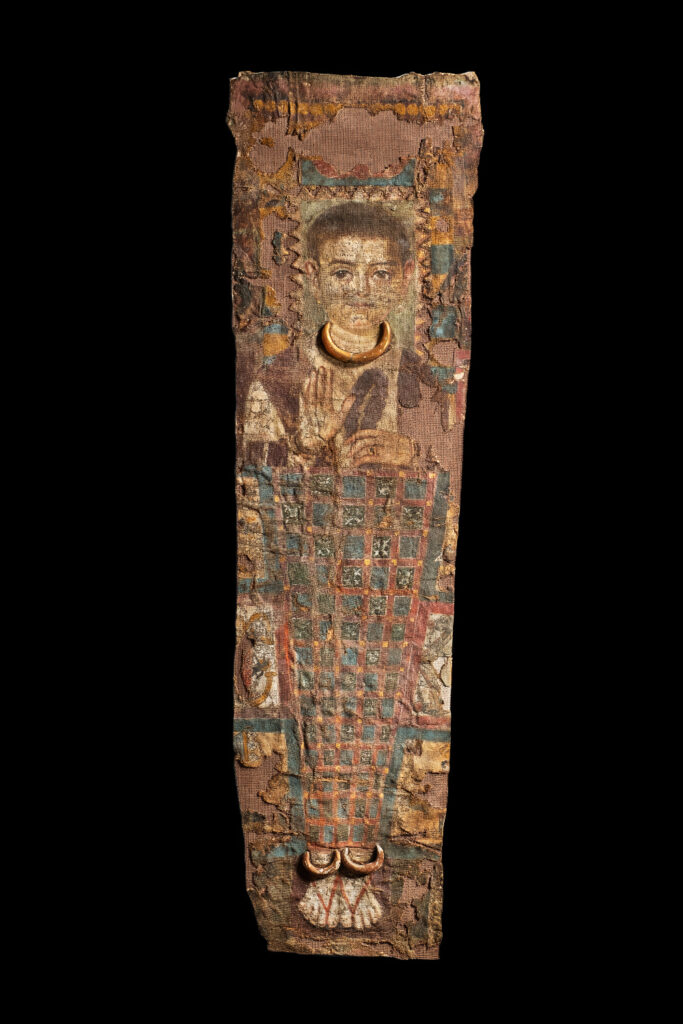
The shroud is made from linen, with a thin layer of painted gesso (plaster) on top. It measures 117 × 33 × 1.3 cm. The plaster’s quite badly damaged in places, making parts of the decoration hard to make out. A depiction of the little girl herself takes up most of the shroud.
We don’t know much about its origins, but the style of the shroud is similar to others found at the Roman-era city of Antinoe. It likely dates to around 280–350 CE.
There was no coffin accompanying the shroud (that we know of), or the remains of its owner, so we have only the shroud itself to work from.
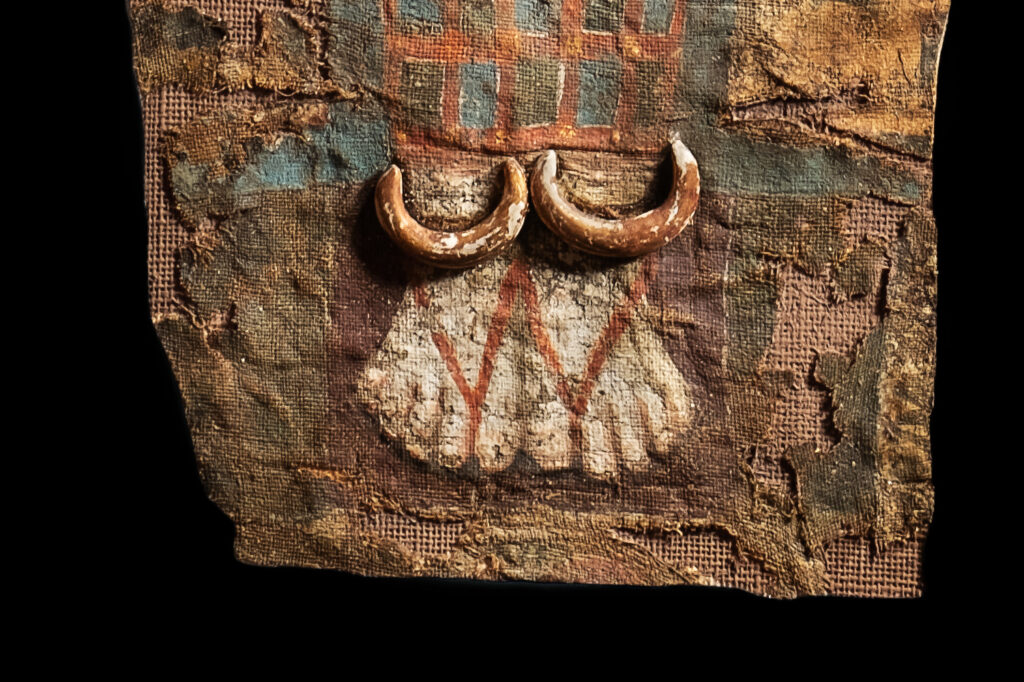
On the shroud, we can see her head, upper torso, and her feet; the rest of her is covered by a bead-net covering containing rosettes in alternating squares. Her hair’s cut short, and she wears a white dress with purple trimming, earrings, a ring, and – as you will probably have noticed as soon as you saw the picture – protruding necklace and anklets made from gold-painted plaster.
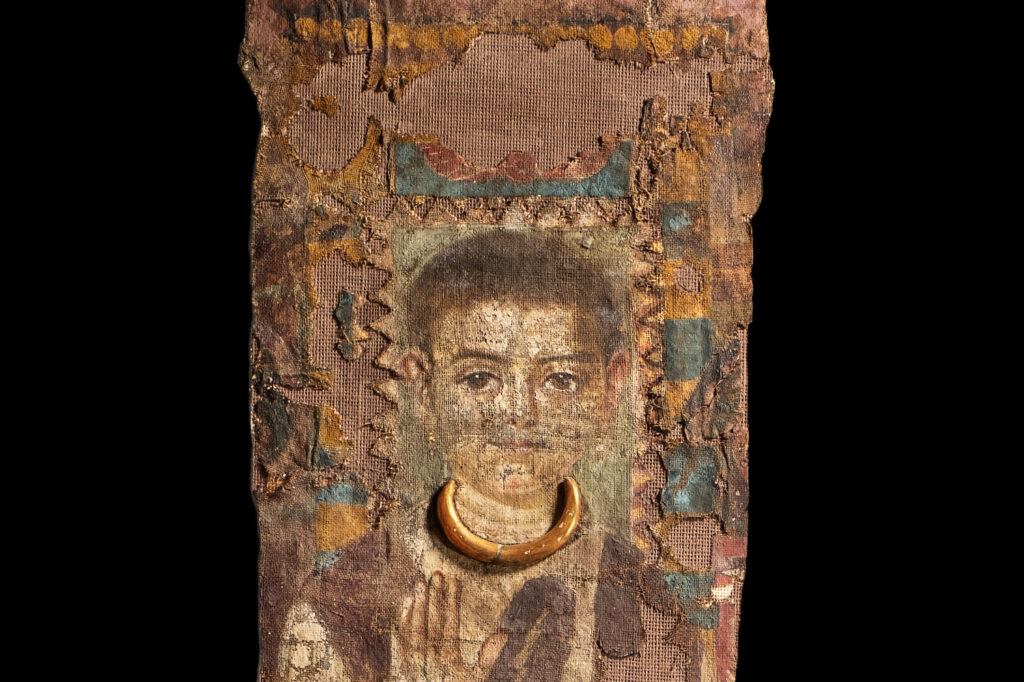
She looks out at us with a serene look on her face, typical of funerary portraits of the time. Her right hand is held up in a gesture of greeting or prayer, and her left clutches a small garland of flowers.
Most of the decoration around her is badly damaged. However, we can make out the remains of a shrine-like structure around her head.
It’s yellow and blue in colour and, if you look carefully, you can see a winged sundisk just above her head and rearing cobras on either side.
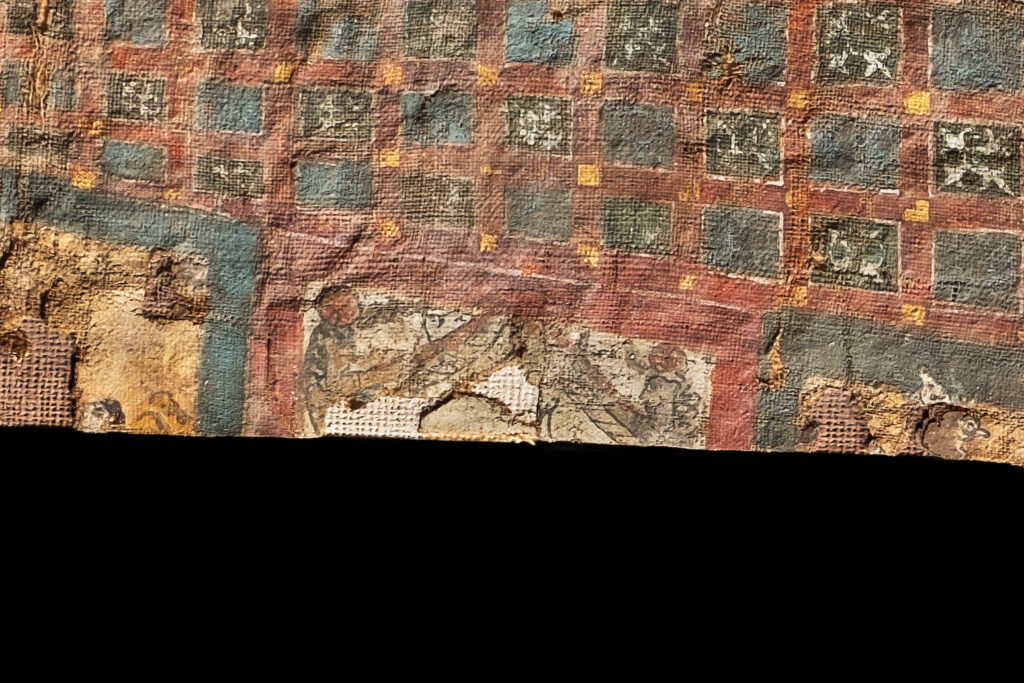
Further down, next to her legs, are an embalming scene (left) and winged goddesses (right):
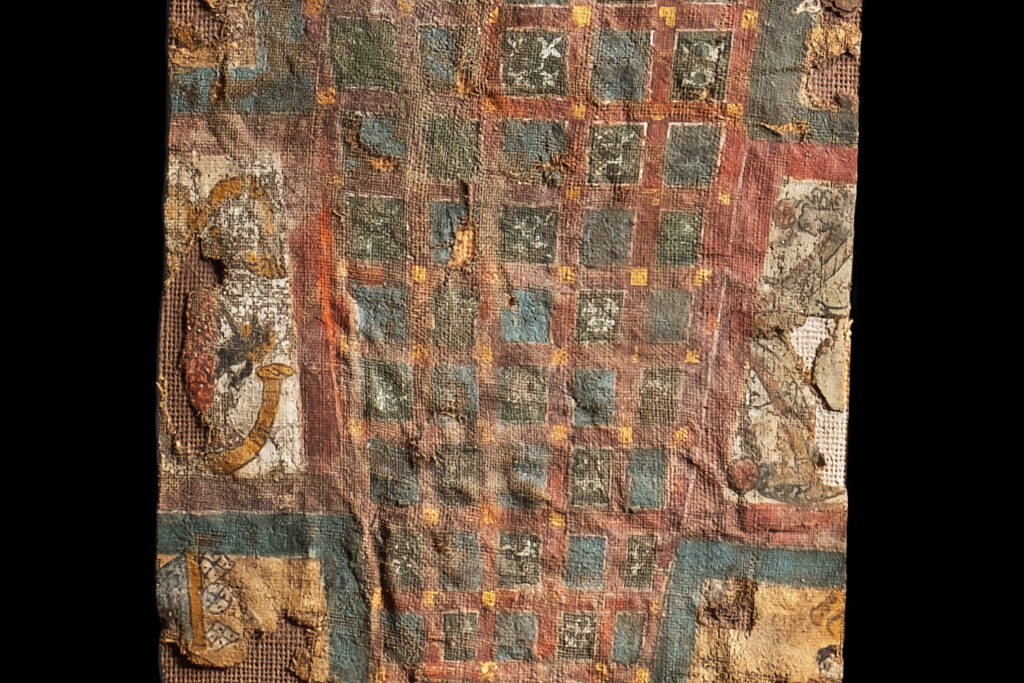
Firstly, here’s the embalming scene. You can see Anubis in the centre, tending to the girl on a funerary boat.
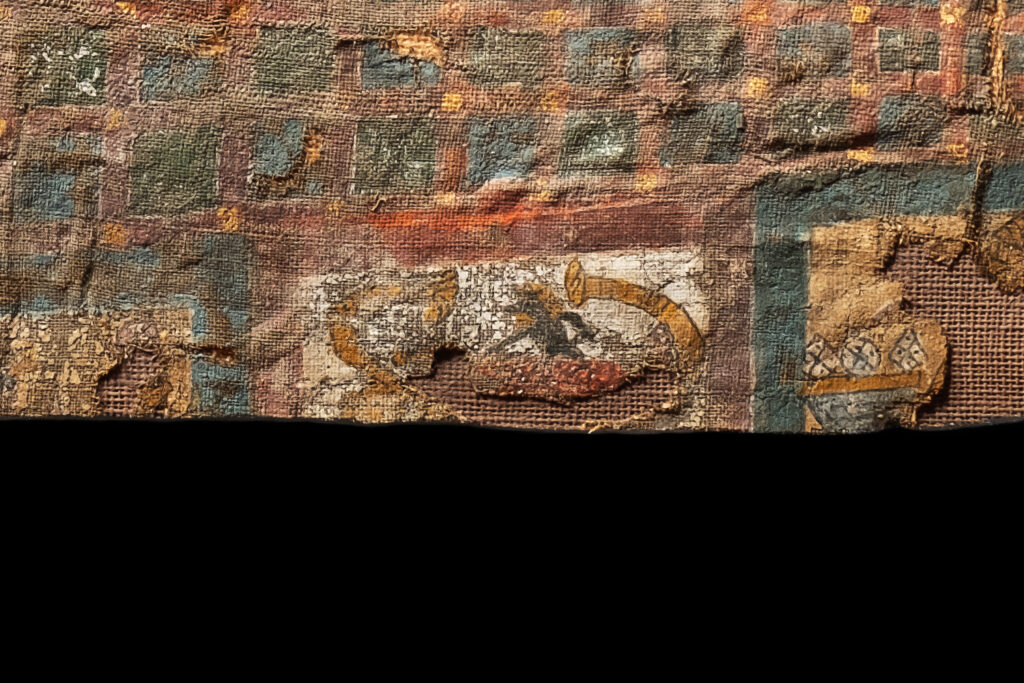
On the other side of her legs are two winged goddesses with sundisks on their heads. They’re facing each other and have an outstretched arm each, meeting in the centre. By this point in Egyptian history, depictions on coffins and mummy coverings of what used to be Hathor, Isis and Nephthys became somewhat generic winged goddesses with no identifying headdresses or labels. So, all I can tell you here is ‘winged goddesses’.
What do we know about the child?
Unfortunately, very little. The decoration on the shroud is, like many other coffins and mummy coverings of the time, formulaic in what it shows. There’s no writing – Egyptian, Greek or Latin – to give us her name, which I find particularly poignant.
We don’t have anything but the shroud. The shape of the shroud is rough and irregular, looking like it had been cut away from something else, perhaps a coffin or cartonnage casing. If the child had remained with her shroud, we might have been able to learn more about her; a more accurate idea of how old she was, and what it was that wrenched her away from life at such a young age.
We can’t even be sure that the face we see is the face her family would have looked upon. There’s still scholarly debate about whether these Roman-period funerary portraits were realistic depictions of people, or whether they were a continuation of the Egyptian tradition of showing an idealised version of the person, albeit in a somewhat different style. Dr Campbell Price, the curator who cares for this little girl’s shroud and the rest of the Egypt and Sudan collection at Manchester Museum, has written about this topic, and sits firmly in the latter camp.1
However, because the shroud is only just over a metre long, we can at least suggest she was really quite young when she died. And that, to me, is the saddest part of all.
About the photography
Like the other coffins and mummy covers I photographed for Golden Mummies of Egypt, this shroud came with a different set of photographic needs than the smaller objects I usually photograph.
Although the shroud lives in its own custom-made mount, it’s not something I could just handle myself. It was laid out for me in my photography spot in the organics storeroom, where I could set my camera up on the mezzanine and get a straight-down view.
Because I was having to work in such a tight space, and because of the restrictions I had on how much I could move my camera when it was lashed to the railings on the mezzanine, I had to place the shroud off to the side of the camera to be able to fit my lights in next to her, and then correct it during post-processing. Having the lights to the side – rather than overhead and spread evenly – allowed me to really bring out the texture in the linen and plaster.
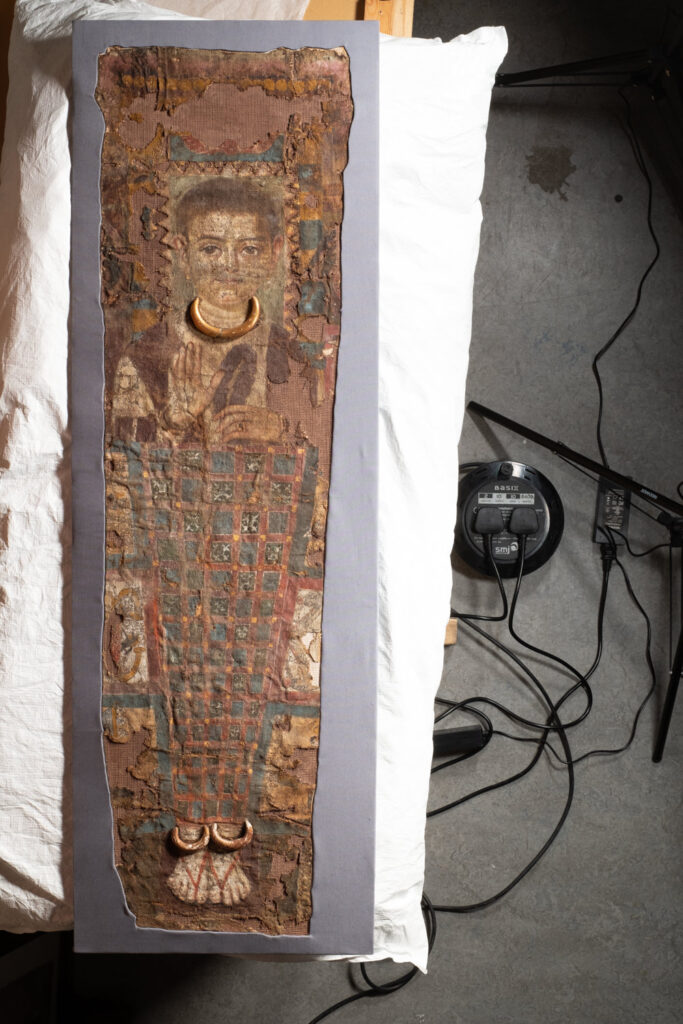
I didn’t need to do any focus stacking, so the final piece is made from just the one photo. However, the real post-photography work came with the removal of the mount. I could have made my life a lot easier and chosen to leave it in, but it’s not part of the original shroud, and because it’s a lighter colour than the shroud itself, it would have been a distraction.
So the bulk of my editing time was spent digitally cutting the mount (and the rest of the background) away from the shroud. I did this by first creating a rough selection of the shroud using Photoshop’s selection tool, then zooming in to 300% magnification and slowly, carefully working my way around, refining the edges with a 10-pixel-wide brush and adding a plain black background. (For context, the image itself is 6000 × 4000 pixels.) This stage took a few hours to complete.
The rest was relatively simple; some work on exposure and contrast, a teensy bit of sharpening to highlight the texture in the surface of the gesso and linen, and some targeted contrast on details that needed bringing out a little.
And there you have it. I hope I have done this little girl – who died before she even got a full taste of life – justice, and allowed her to shine a little.

Although the shroud was part of Manchester Museum’s Golden Mummies of Egypt exhibition, now the exhibition has finished, it’s no longer on display, so the only places you can see it are on the museum’s collections database, in the Golden Mummies of Egypt book, and here. You can also see the photo on my Flickr account, where you can view – and zoom in to – the photo in its original dimensions.
Thank you for taking the time to read this article. If you’ve enjoyed it and would like to support me, you can like/comment, share it on your favourite social media channel, or forward it to a friend.
If you’d like to receive future articles directly to your inbox you can sign up using the link below:
If you feel able to support me financially, you can:
- become a patron of my photography by subscribing for £3.50 a month or £35.00 a year on Substack
- gift a subscription to a friend or family member
- if you would like to become a patron, but don’t want to pay via Substack, you can buy an annual subscription directly. Once you’ve purchased, I will add you to my list of patrons on Substack so you receive my patron-only articles
- or you can tip me by buying me a virtual hot chocolate (I’m not a coffee drinker, but load a hot chocolate with cream and marshmallows, and you’ll make me a happy bunny …)
With gratitude and love,
Julia
Unless otherwise credited, all photos in this post are © Julia Thorne. If you’d like to use any of my photos in a lecture, presentation or blog post, please don’t just take them; drop me an email via my contact page. If you share them on social media, please link back to this site or to one of my social media accounts. Thanks!
- Campbell discusses this topic in both the Golden Mummies of Egypt book and Ancient Egypt in 50 Discoveries. ↩︎