

Artefacts in focus #4: a ram-headed sphinx amulet
If I were to say the word ‘sphinx’ to you, I would put money on at least 99 out of a 100 of you thinking of the Great Sphinx at Giza before anything else.
Go on, tell me I’m wrong 🙂
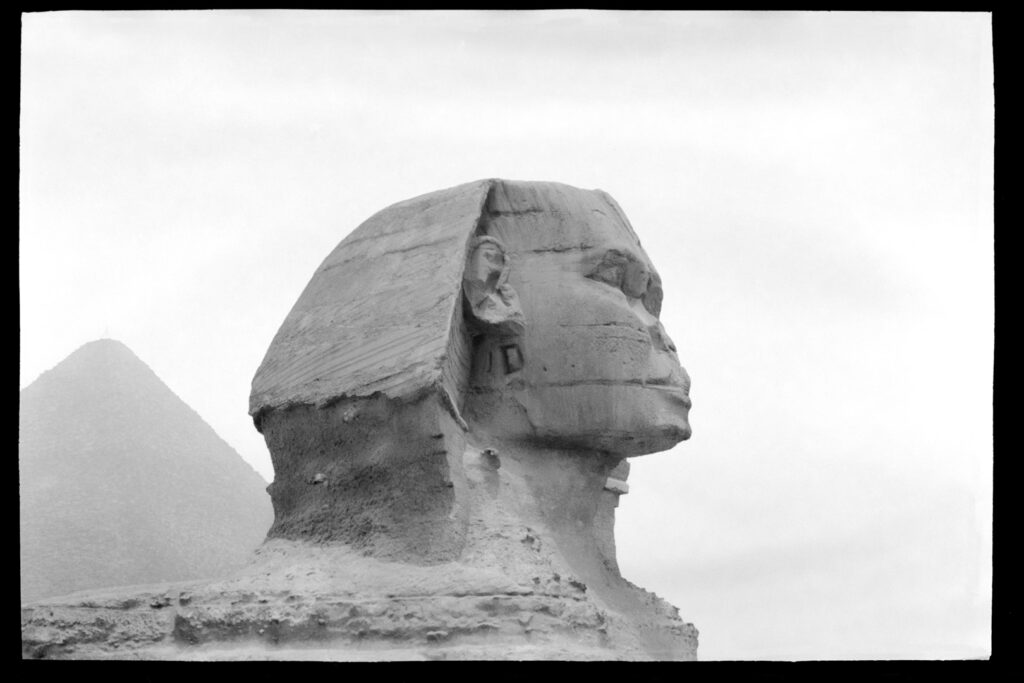
Hewn from a natural outcrop of stone on the Giza plateau, the Great Sphinx has guarded the three pyramids, and their associated temples and satellite tombs, for millennia, and it is, to this day, considered one of the world’s greatest sculptures,
But, there’s more to sphinx mythology than just the majestic guardian of the pyramids.
The sphinx has taken a long and winding route through history, from the guardian of Egyptian tombs and temples, to the female, bare-breasted sphinx who protected the ancient Greek city of Thebes by challenging entrants to answer her riddle, to the temple guardians of southern Asia. The Greek-style sphinx re-emerged in 15th-century Renaissance Europe, and the original Egyptian sphinx finally rose from the ashes as part of the Egyptomania craze of the 19th century.
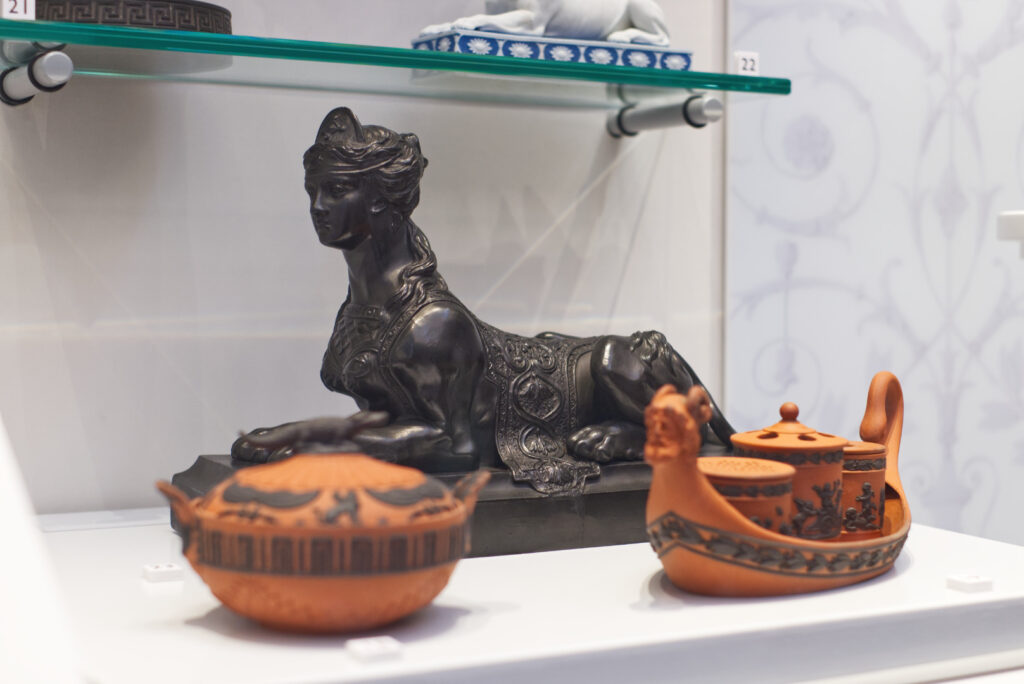
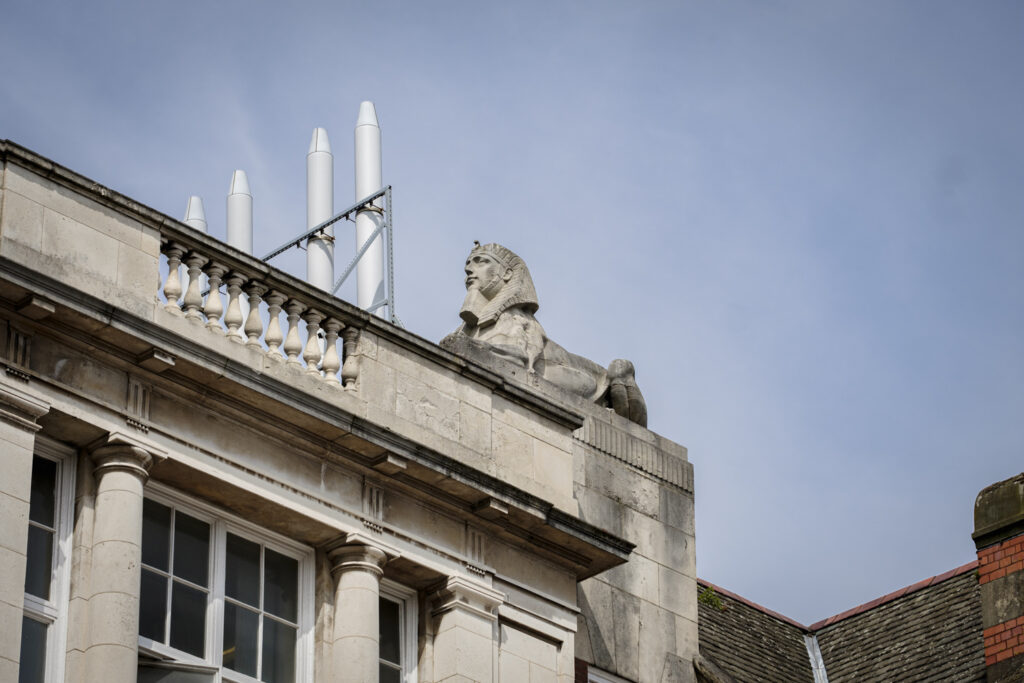
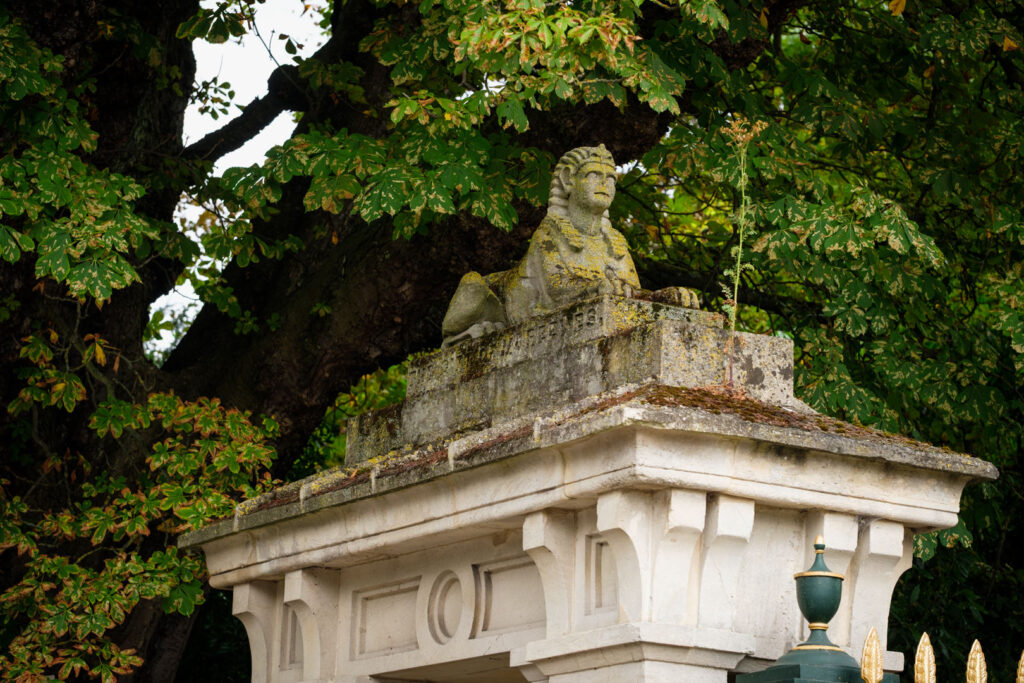
And if there’s one word that encapsulates the creature, it’s ‘guardian’.
Sphinxes guard places – temples, tombs, palaces and cities – and their inhabitants, which is likely to have contributed to their popularity over the millennia.
Types of Egyptian sphinx
The earliest sphinxes date back to the Egyptian Old Kingdom (c.2686–2181 BCE; the time of the Great Sphinx and Giza Pyramids), and comprised a lion’s body in a recumbent pose (lying down with the front legs out straight and the back legs tucked up) with a … not lion’s … head. There were three main forms:
- The androsphinx, which had the head of a man, associated with royal power. The Great Sphinx at Giza is one of these.
- The criosphinx, which had the head of a ram (species Ovis aries platyura-aegyptiaca), associated with Amun (and later, Amun-Re).
- The hieracosphinx, which had the head of a falcon, associated with Montu, the Theban god of war.
These sphinxes guarded temples and tombs, such as those at Giza. You might also be familiar with the Avenue of Sphinxes lining the ancient processional route between Karnak and Luxor temples.
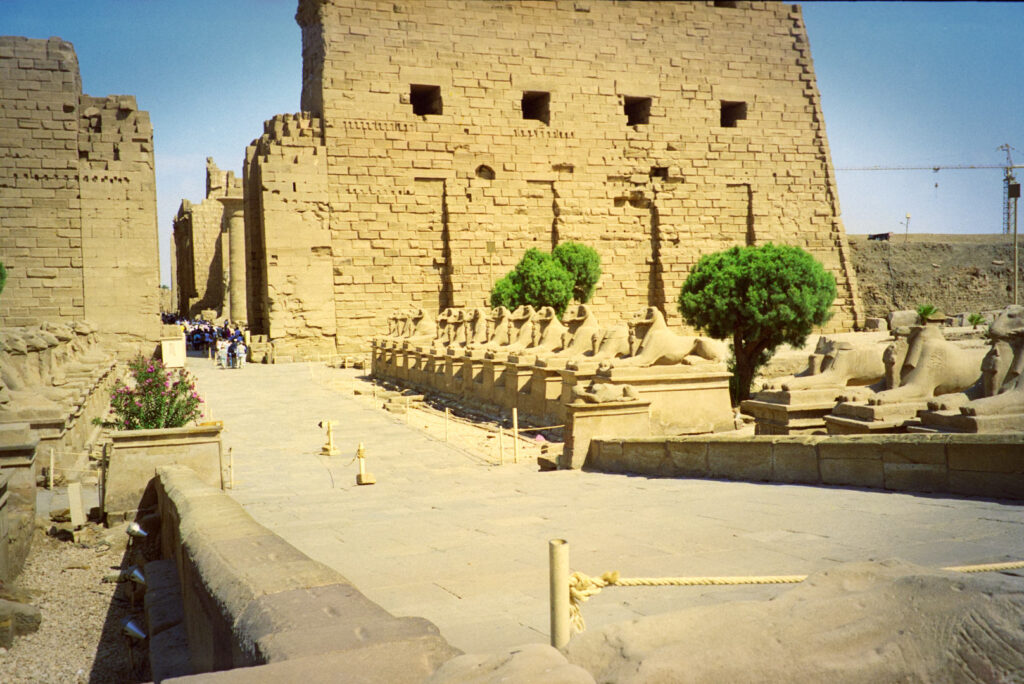
OK, so as you might be able to tell from my photos above, I’m partial to sphinxes (as well as mythology in general and Egyptian Revival art and architecture), and I like to grab my camera whenever I see one guarding something. So it was only natural that I’d want to add to that collection and photograph some more examples. Finally, I got my hands on one at the Garstang Museum of Archaeology in March 2025 …

About the amulet
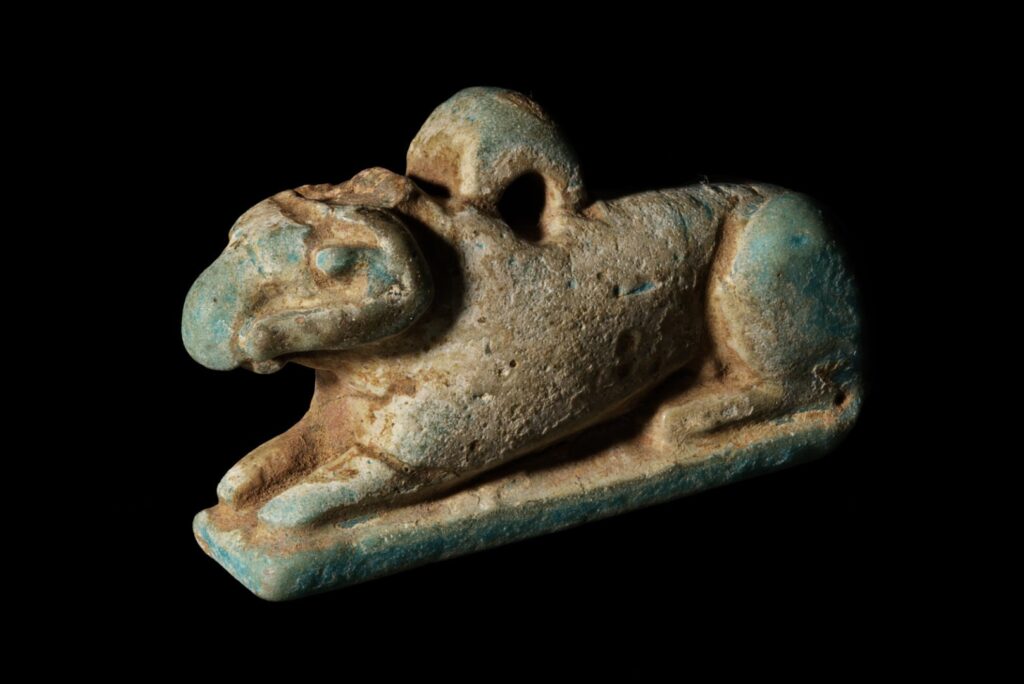
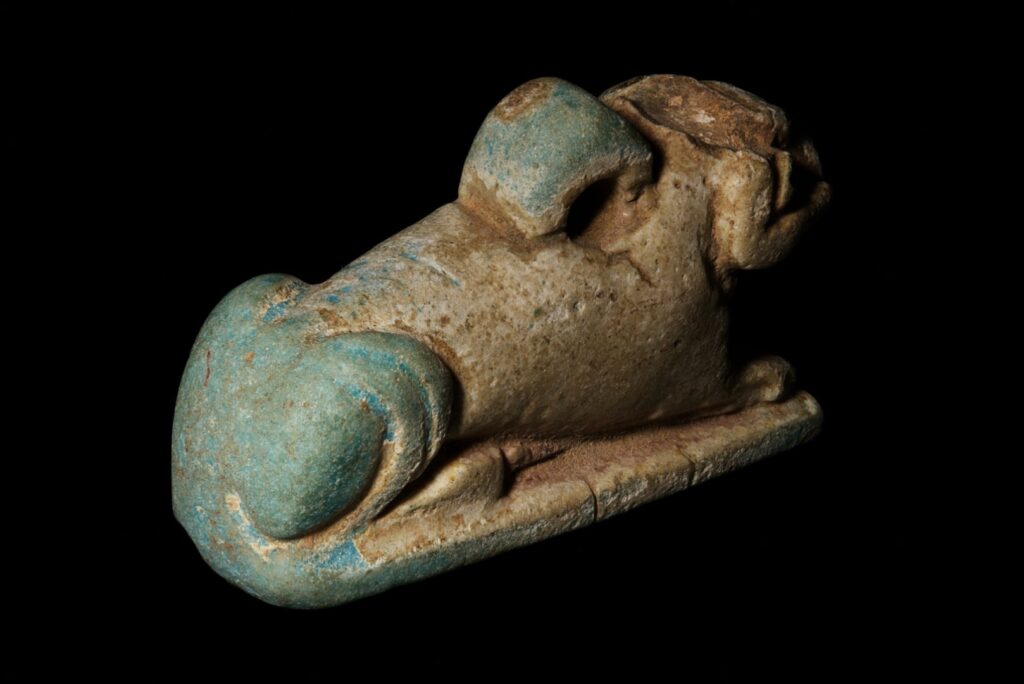
This amulet is a criosphinx: a ram-headed sphinx.
The criosphinx was associated with the god Amun/Amun-Re. It symbolised – and as an amulet bestowed – power, strength and virility.
It’s made of blue-coloured Egyptian faience, though the surface has been damaged in places, and it measures just 3.3 × 1.9 × 1 cm. It has a loop on its shoulders for stringing and it has no inscriptions or markings on the base or elsewhere.
Like many amulets, it’s unprovenanced, so we don’t know when it dates to or which part of Egypt it came from. It was donated to the Garstang Museum of Archaeology by R.W. Hutchinson and has the accession number E.9304.
It’s in the classic sphinx pose, recumbent with its (rather short) front legs stretched out in front and the back legs tucked up. The ram’s head has the horns of Ovis aries platyura-aegyptiaca, which curl along the sides of its cheeks.
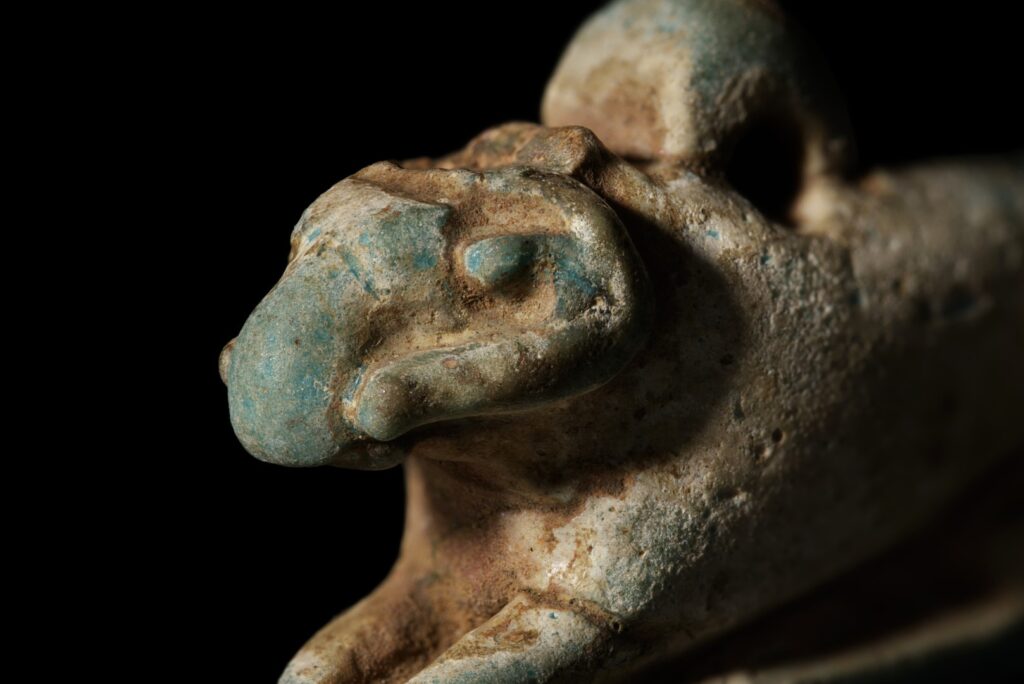
Although the amulet’s well formed – the various parts of the body such as the legs and the horns are clear – there’s no real fine detail; there are no eyes, nostrils, or any detail on the feet.
The amulet has some damage to the top of its head, suggesting a feature that’s now lost.
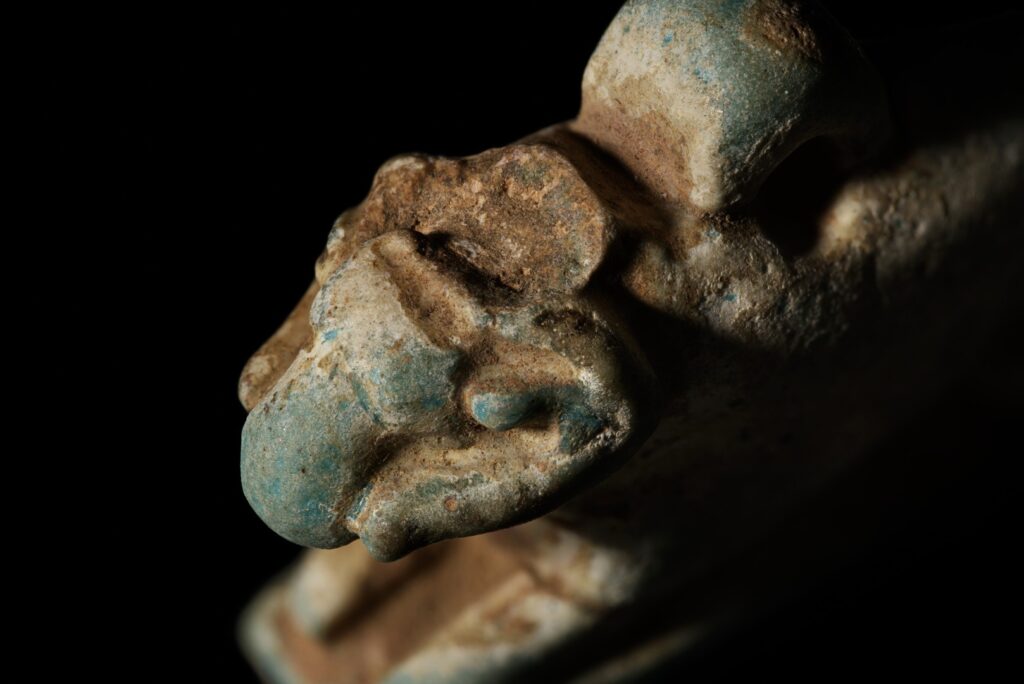
There’s the possibility it might have had a sundisk on its head. Or perhaps the horns rose upwards before they curled down along the cheeks, like this head from a somewhat more colossal sphinx, now at the Museo Egizio, Turin:

As is often the case with these things, we can’t say for sure; we can only make a best guess.
Unlike the colossal sphinxes you’ve seen so far here, the head of this amulet is lowered a little, making it look almost more like a recumbent ram rather than a sphinx. But we know it’s a sphinx because a) sheep (and other cloven-hooved herbivores) don’t lie in that position; they have their legs slightly to one side:

and b) it has a lion’s tail curling around its hind-quarters:
So, a sphinx it is!
About the photography
The rest of this article is for paid subscribers only, as it’s my wonderful patrons who help finance this photography. If you would like to be able to read the whole article, you can do so by becoming a patron over on Substack:
Thank you for taking the time to read this article. If you’ve enjoyed it and would like to support me, you can like/comment, share it on your favourite social media channel, or forward it to a friend.
If you’d like to receive future articles directly to your inbox you can sign up using the link below:
If you feel able to support me financially, you can:
- become a patron of my photography by subscribing for £3.50 a month or £35.00 a year on Substack
- gift a subscription to a friend or family member
- if you would like to become a patron, but don’t want to pay via Substack, you can buy an annual subscription directly. Once you’ve purchased, I will add you to my list of patrons on Substack so you receive my patron-only articles
- or you can tip me by buying me a virtual hot chocolate (I’m not a coffee drinker, but load a hot chocolate with cream and marshmallows, and you’ll make me a happy bunny …)
With gratitude and love,
Julia
Unless otherwise credited, all photos in this post are © Julia Thorne. If you’d like to use any of my photos in a lecture, presentation or blog post, please don’t just take them; drop me an email via my contact page. If you share them on social media, please link back to this site or to one of my social media accounts. Thanks!

[…] been a couple of months since I last wrote to you, when I shared my article about the sphinx amulet I photographed earlier this year. Time really […]