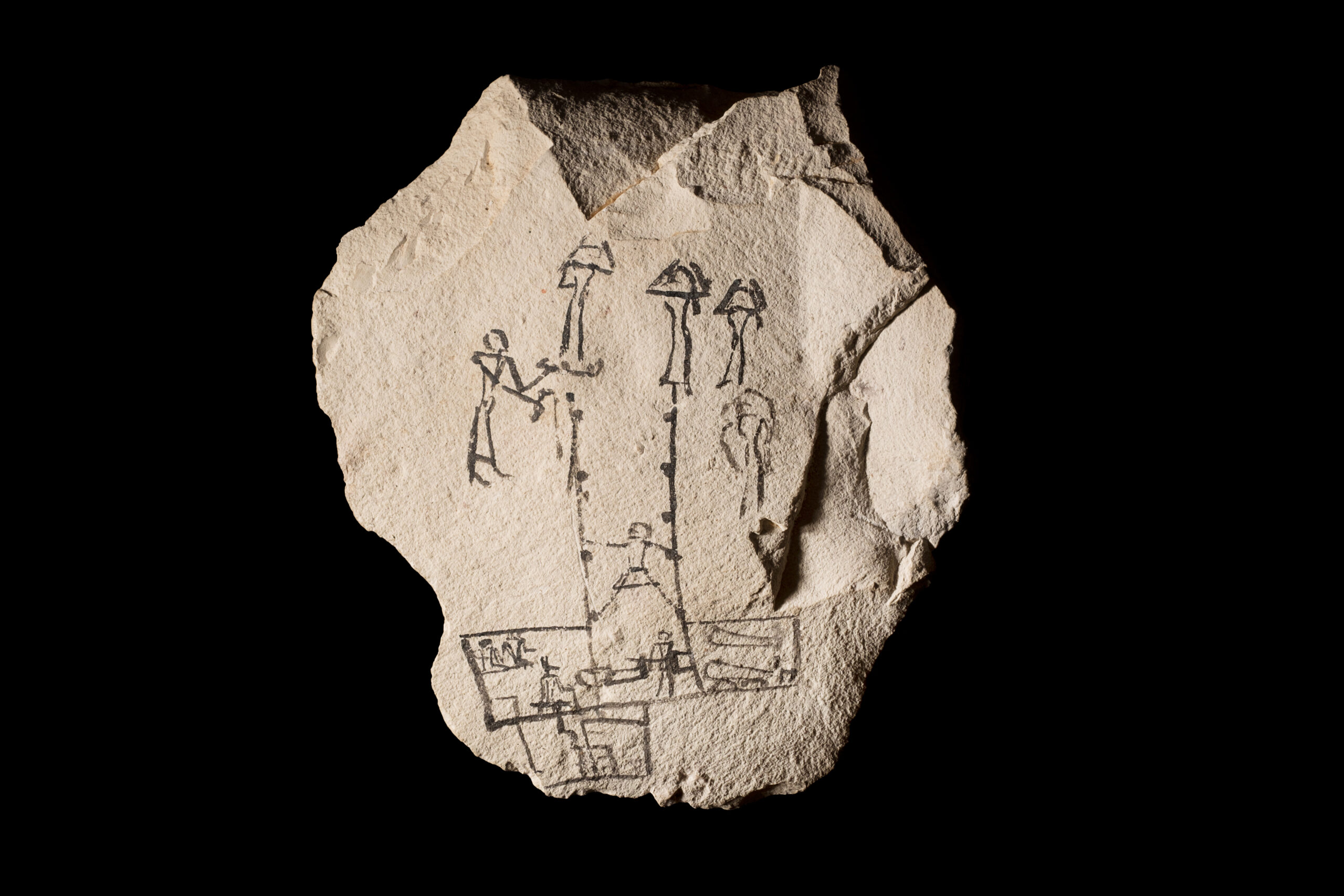
Artefacts in focus #5: an ostracon depicting a funeral
Sometimes I come across an artefact – shared on social media by a museum, a curator, or someone on a museum visit – and it just captures me, so I add it to my wishlist of Artefacts I Would Love To Photograph.
One of those objects was an ostracon that I’d seen Dr Campbell Price, Curator of Ancient Egypt and Sudan at Manchester Museum, share on social media several years ago.
It’s a shard of limestone with an illustration depicting an ancient Egyptian funeral, and it’s a fascinating piece. So when Campbell asked me to work with him on the museum’s To Have and To Heal project back in 2022, I was excited to find out this object was one of those selected for the project.
About the ostracon
Before we go any further, what is an ‘ostracon’?
The word ‘ostracon’ (plural ‘ostraca’) comes from the ancient Greek for a sherd (broken fragment) of pottery. Traditionally, the decision to banish a person from Greek society was made by their peers by scratching their name on pieces of broken pottery to cast their vote (hence our word ‘ostracise’).
However, the word is also used in Egyptology to refer to pieces of stone that were used as a writing surface. Papyrus was expensive and tricky to make, so people would often use flakes of stone – limestone in particular – for writing everyday notes and lists, and artists and their apprentices would use them for practicing on.
Because they were used in this way, and because of the dry, preserving nature of the Egyptian climate, thousands of surviving ostraca have helped give us a real insight into the daily lives of ancient Egyptians.
About the sketch
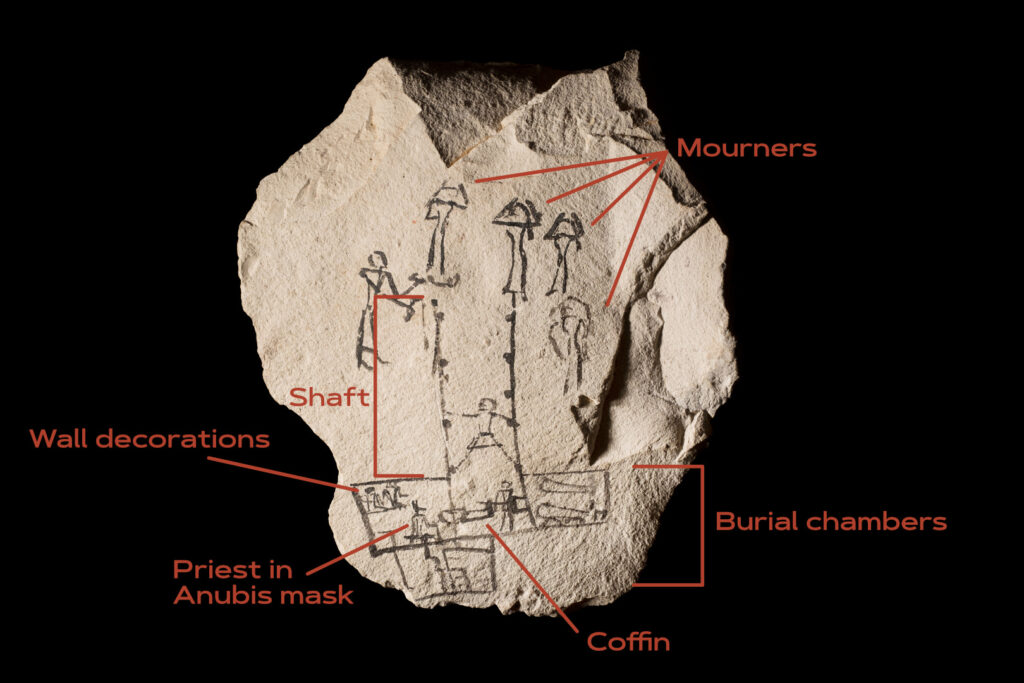
The scene on this ostracon depicts a funeral taking place at a tomb and is, as far as I know, unique. The style is cursive with stick figures and it looks like it’s been done quickly without much prior thought or planning (although I do think the stick-figure people are packed full of character).
Starting at the top, we can see a group of female mourners, with their hands up to their faces, similar to this:
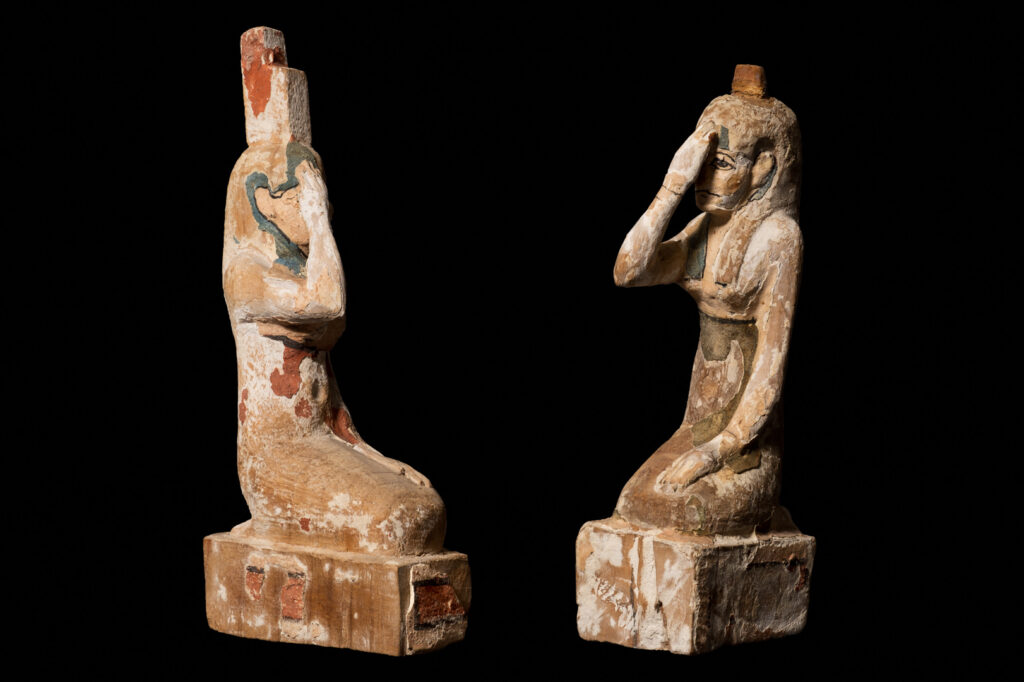
Alongside them is a man holding … something … in his hands (tray of food offerings? tools? ritual objects?).
They stand at the entrance of the shaft of the tomb, which has another man shimmying his way down to (or up from) the tomb chamber using hand/foot-holds set into the sides of the shaft.
Moving down to the bottom of the shaft, we find the coffin of the deceased attended to by a priest wearing an Anubis mask, with another member of the funerary team at his feet.
On the right is another two coffins, suggesting this might be a tomb of multiple occupancy; a family tomb, perhaps (common for private tombs).
On the left is another chamber with two kneeling figures in the upper left corner and a box in the bottom left. This is possibly a depiction of wall decorations.
At the very bottom is a second chamber.
This piece is really interesting in that it shows us what is probably a more realistic depiction of a funeral compared to the overly formulaic illustrations found on actual tomb walls.
In particular, it confirms to us how workers moved up and down tomb shafts, and it confirms that part of the funeral took place actually in the tomb, rather than the coffin merely being lowered down the shaft and sealed in.
Where has the ostracon come from?
This ostracon (accession number 5886) was donated to Manchester Museum by Sir Alan Gardiner (for any of my readers here familiar with academic Egyptology, yes, that’s Gardiner of Gardiner’s Egyptian Grammar: Being an Introduction to the Study of Hieroglyphs fame). All we know is that it came originally from the West Bank of Thebes (modern Luxor), but it most likely comes from Deir el-Medina.
Deir el-Medina (Set-maat, ‘The Place of Truth’) was the village just on the edge of the desert on the Theban West Bank that housed the craftspeople who built the tombs of pharaohs and other members of royalty in Thebes during the New Kingdom (c.1570–c.1069 BCE). Not only were they a community of artisans with a plentiful supply of waste limestone from the tombs they constructed, the tombs they built for themselves in the village – unlike the large, complex tombs of the pharaohs – were relatively simple constructions. They had a ground-level courtyard and chapel area, often with a small pyramid atop. There would be a vertical shaft or staircase leading to underground burial chambers.
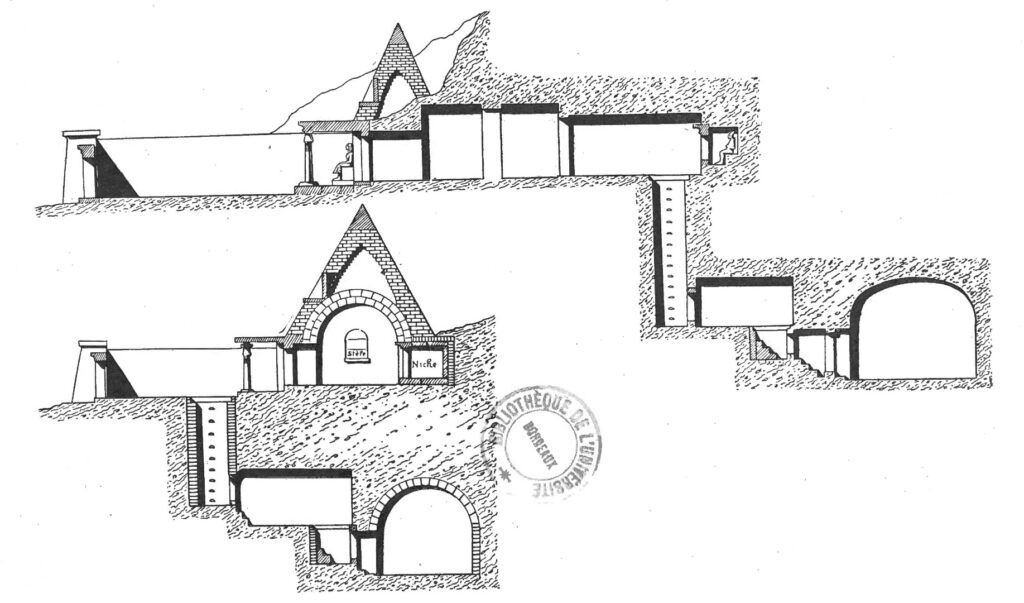
This layout is remarkably similar to that on our ostracon.
Tombs were created by digging into the ground or excavating into the limestone cliffs in the desert and so we have a wealth of ostraca created by literate people using the virtually limitless supply of stone fragments that were available as a result of tomb-building. The ostraca found there have included medical texts and treatments, legal documents, and artists’ sketches and trial pieces.
So, the fact that the tomb layout mimics that found at Deir el-Medina, and artistic ostraca found at Thebes generally come from the village, it seems unlikely it would have come from anywhere else.
What is the purpose of the piece?
This is actually a really interesting question. The purpose of some ostraca is obvious, such as written documents:
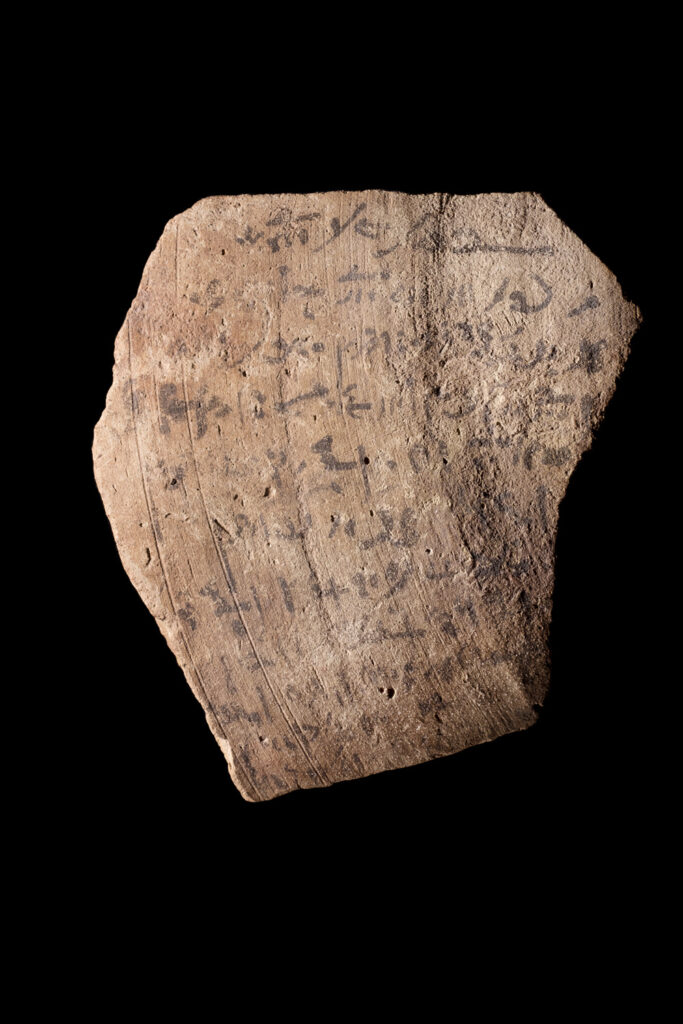
Some ostraca from the Theban West Bank look to be either training pieces by apprentice artists or artists’ trial sketches, where the initial composition is made in red ink and then corrected and/or finalised in black:
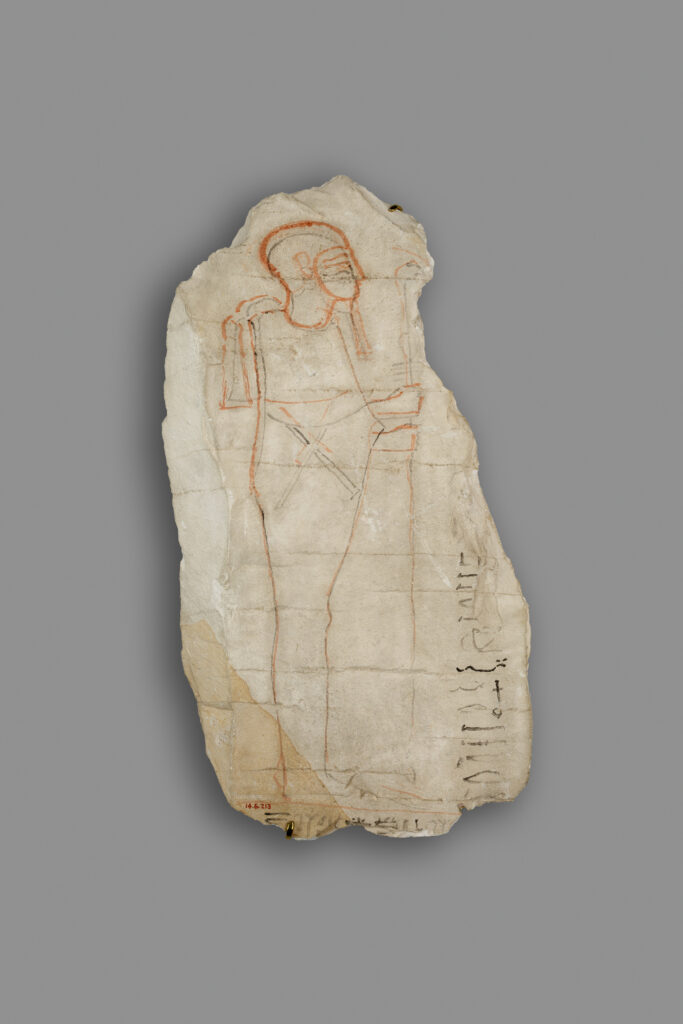
Or a practice piece where a grid is drawn in red ink to guide the artist so they can learn to achieve correct proportions (the ‘canon of proportions’ as we call it in Egyptology):
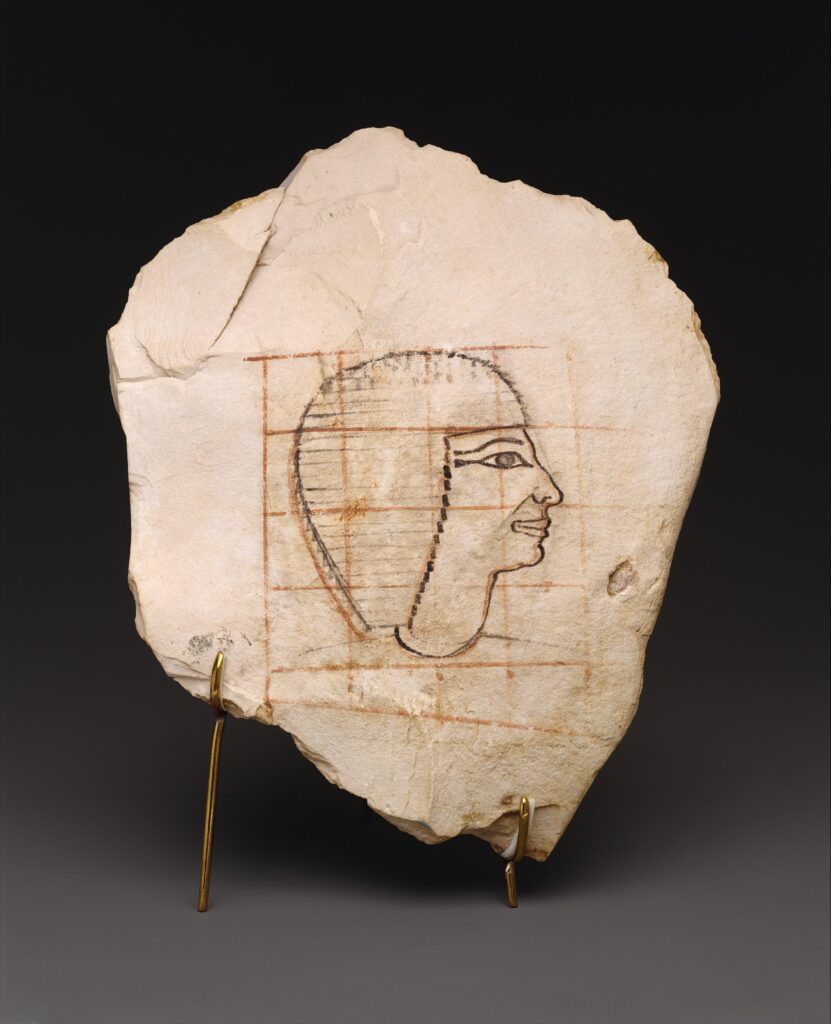
Other ostraca depict satirical or humorous scenes, such as the famous cat-serving-a-mouse scene (step aside, Tom and Jerry!):
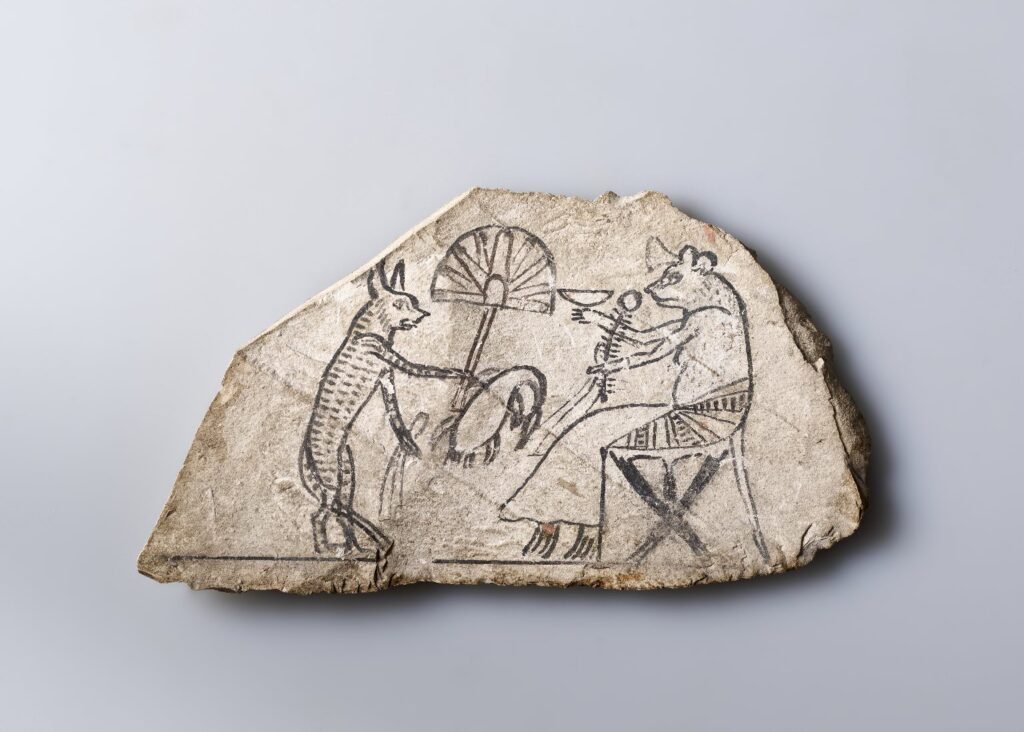
This ostracon doesn’t belong to any of these categories. There’s no text, no traces of red ink and the subject certainly doesn’t fall into the category of ‘humorous’.
So, what is it?
The sketching looks to be rough and quick, so I don’t think it’s ‘official’ in any capacity.
I suspect – though I may be wrong – that this may be something as simple as a demonstration sketch. Imagine an artisan or tomb-builder at Deir el-Medina sitting down with his son or new apprentice, describing a tomb or funeral.
“So, we start here, at the chapel with the mourners. Then we have the shaft – which we shimmy up and down using these little handholds you see here – which leads to the burial chamber, where the priest wearing the mask of Anubis performs the final rites of the funeral …”
Etc., etc.
I may be falling foul of the perennial problem of modern eyes and modern perceptions trying to interpret an ancient culture, but I’m not sure what else it could be. If you, dear reader, have any thoughts yourself, please do let me know in the comments section below.
About the photography
This was a relatively simple piece to photograph. The main issue with the set up was getting the ostracon to sit flat. Because it’s a flake of limestone, rather than a worked piece, the back isn’t flat. To get it to sit flat, I used a bit of packing material underneath.
I lit it using a single, small LED light mounted on my Joby GorillaPod, a small tripod with bendy legs. I attached the light to my camera tripod by wrapping the legs of the GorillaPod around the leg of my tripod. I did this because it was the best position for getting the light I wanted. I wanted the light to skim across the surface enough to bring out the texture in the limestone, but not so much that it would make it hard to see the actual sketch.
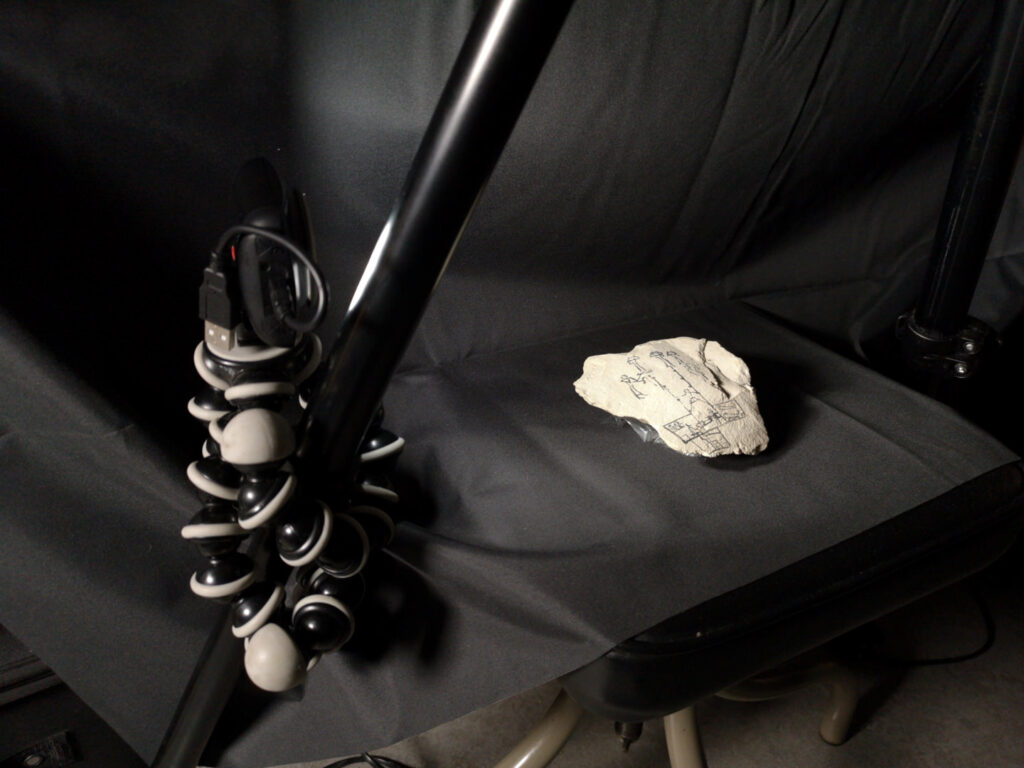
I photographed the ostracon in its entirety, then went on to get a couple of detail shots:
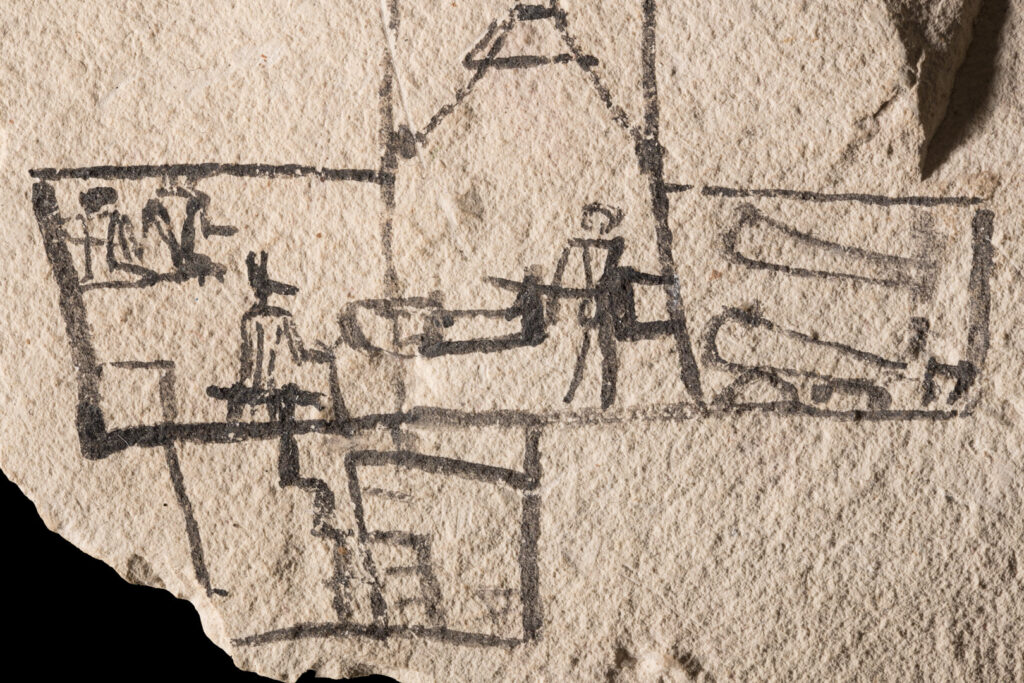
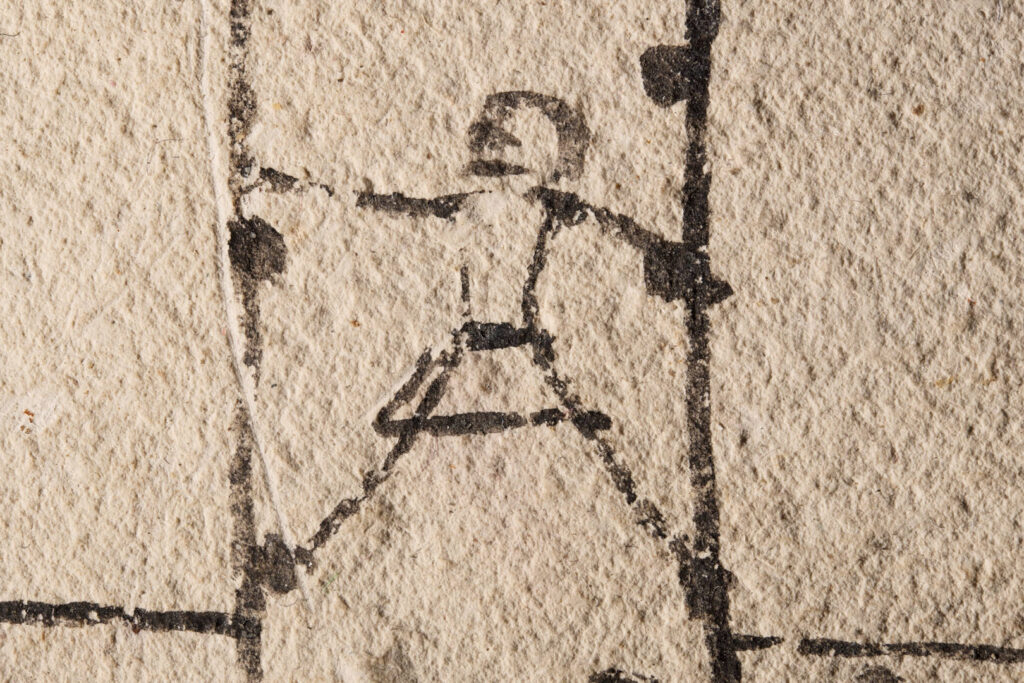
One of the things I love about producing images like this is that the careful lighting and macro lens really allow you to start seeing how the artist worked. You can see where they started a line and finished it, due to the thicker layer of ink at one end, which then gradually becomes thinner and lighter. It highlights the story of this object beyond just the contents of the illustration.
I also think it’s wonderful that what was possibly just a throwaway ‘FYI’ diagram sketched quickly and without much thought has become an object of academic interest and aesthetic delight. I wonder what the original artist would think of all this …
Useful links

Thank you for taking the time to read this article. If you’ve enjoyed it and would like to support me, you can like/comment, share it on your favourite social media channel, or forward it to a friend.
If you’d like to receive future articles directly to your inbox you can sign up using the link below:
If you feel able to support me financially, you can:
- become a patron of my photography by subscribing for £3.50 a month or £35.00 a year on Substack
- gift a subscription to a friend or family member
- if you would like to become a patron, but don’t want to pay via Substack, you can buy an annual subscription directly. Once you’ve purchased, I will add you to my list of patrons on Substack so you receive my patron-only articles
- or you can tip me by buying me a virtual hot chocolate (I’m not a coffee drinker, but load a hot chocolate with cream and marshmallows, and you’ll make me a happy bunny …)
With gratitude and love,
Julia
Unless otherwise credited, all photos in this post are © Julia Thorne. If you’d like to use any of my photos in a lecture, presentation or blog post, please don’t just take them; drop me an email via my contact page. If you share them on social media, please link back to this site or to one of my social media accounts. Thanks!